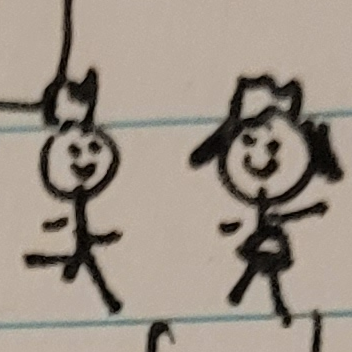
One ticklish thing for me about writing a book about my personal inner child work – which is now in its fourth decade (the inner child work, that is, not the book writing) – is the felt need to connect what I do with the various “published” theories and techniques.
It could be that there actually is no need to do that – I don’t know that an average reader would actually care (if it happens that you’re an average reader, do let me know if you’d actually care) – but I’m trained as a social scientist, so it seems imperative to me to situate myself and my work in that way. Interesting, too, actually.
Plus: publishers want to know where any new book fits in with all of the old books – helps them evaluate the viability of the project – so I’ve got to do the work, anyway.
And, while Not a Monster (our book) is offered mostly as just one person’s story, it does describe what – according to my survey – appears to be a unique approach to inner child work and related recovery activities. Thus, it might be something that other people would like to know about. Accordingly, differentiating it from the pack could be valuable. And that’s what’s going to happen here.
If you haven’t read the introductory blog you might wonder about our use, now and again, of the 1st person plural pronoun. Though there is only one Michael at the keyboard, there are, as you can gather from the content of some of the posts, multiple active occupants in our psyche, so the plural pronoun is often preferred. There are many occasions, though, on which, for any number of reasons, the singular seems more apt, so it appears regularly as well.
My work
I started with inner child work and got it wrong right away; then it unintentionally expanded into something like what’s commonly known as shadow work, or maybe it was more like the Internal Family Systems approach, or both. I didn’t hear about either of those (as far as I recall, anyway) until 30 or so years after I read my first book on inner children (Ann Brebner’s Setting Free the Actor, 1990), so any similarity is evidence of, I don’t know, the fact that it’s all real, or something.
My psyche pretty much unfolded itself to me in its own way and time, and it doesn’t exactly match what Jung (shadow work) or Schwartz (IFS) and their followers and interpreters have described. So, I’ve either got a weird psyche, have dramatically mis-portrayed myself to myself, or the theories on offer are all pretty much approximations. Each and all of these seem possible.
Let me get a little more detailed on what and where the differences are. If I’m lucky, some of you will share your thoughts on how I should approach it all in Not a Monster.
First aberration: multiple inner children
One of my shadow figures, The Lady in White, once referred to my 27 inner children as “little naked mock-ups of yourself.” What a great phrase! Really, I should respect her work and quote the whole line: “At your best,” she wrote in response to a line of affirmation work, “you’re lost in your head, wandering around your fucking imaginary reef with little naked mock-ups of yourself.”
So yeah, I had, at one point, 27 inner children, which is probably against the rules. But if I’ve learned anything in years of 12-step meetings, it’s that, if something’s happened to me, something like it has happened to butt-loads of other people, too. So maybe it’s the “literature” (in which I include videos and podcasts and all – I’m just old school in my language) that has a deficit that we can fill.
When I was starting the work, there was only one source that I encountered that acknowledged the possibility of more than a single child within. That was the Ann Brebner book that I started with. A wonderful book, long out of print, it had a single example of a client with a pair of inner kids. I forget if they exhibited any sibling rivalry, but mine sure have. And learning to deal with that is just one of the skills that that no other book, to my knowledge, teaches.
Of course, if I had encountered something like John Bradshaw’s classic book, Homecoming: Reclaiming and Championing Your Inner Child (1992), earlier than last month, I might have gotten stuck with just one young Michael inside. Bradshaw recommends visualizing a room with two comfy chairs, inviting your youngster in, offering them a chair, then asking how old they are that day.
Well, that solves the problem: only one kid allowed. Me, I visualized an open glade, and whoever showed up, showed up; every age demanded their own self – or at least availed themselves of their own selves.
No chairs, no limits: the consequences of being an anarchist.
Second aberration: multiple other characters
Like any good practitioner of inner child work, I hung out with the crew meditationally. One of the things we would do – as The Lady in White said – was to wander around the visualized space we hung out in. Just start walking and let the landscape around the original “happy place” expand beneath our feet. It grew, in time, to be quite extravagant. I have elaborate hand-drawn maps to prove it.
More to the point here, it grew populated.
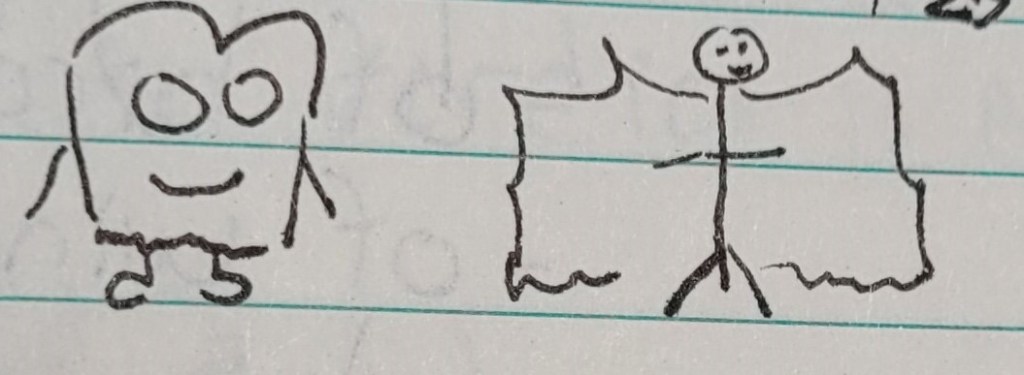
One day our wandering brought us up a hill, and before we crested it, up from the other side came a horde of large, furry, orange molars on legs – or so they seemed. When asked who they were, they answered: “Your Desires.”
Well, dang. You, of course, have recognized them – as we quickly did, once we got over our shock at finding other inhabitants in what we thought was the exclusive preserve of Michaels – as a multiple of Gossamers, the monstrous opponent of Bugs Bunny in several Looney Toons cartoons from back in the day.
So, that’s when we tipped past the bounds of inner child work into something else. And it wasn’t our fault, let me add: it just happened, and things like that kept happening. Later on, a swarm of Tasmanian Devils (Looney Toons variety) swept in and took over a forest; a huge crowd of three-armed aliens, modeled on characters from a Larry Niven/Jerry Pournelle novel, popped up and took over a different forest; urchins in board shorts grabbed a beach, pterodactyls flickered across the sky, giant babies peeped over mountain tops, so on and so forth. Embarrassing to write about, really. And in case you were wondering, the little Taz’s were Doubts; the aliens, Worries; the pterodactyls, Anxieties; the urchins were just little guys that liked to party, we never have figured out what their deal was; and the baby (just one – I didn’t want to screw up the parallel structure) is another mystery. It’s the mind, you know? We’re never going to get to the bottom of it.
At any rate, these guys – and that’s “guys” in the gender-neutral sense: they were male, female, agender, non-gendered, nonbinary, hermaphroditic, and/or unable to understand the question – these guys don’t belong in the inner child world. They are the things you and your inner child talk about, not with, much less write poetry, have barbeques, or play war games with.
Some of them probably qualify as shadow figures, inasmuch as at least some of them represent disavowed parts of ourself, just like shadow figures should (though some of the Michaels actually qualify better as that); on the other hand, they don’t have the gravitas one expects of those archetypes of the collective unconscious that are supposed to populate the shadow.
Some of them better fit the IFS categories of Managers or Firefighters, respectively the parts of us that run our day to day life and the parts that manage our feelings; actually, a lot of them do, probably, though they all seem to slop over the sides of those roles, too.
In the end, though, my inner landscape is full of characters who don’t fit the available schemas, or refuse to play the proper parts in them. Yours may be as well, and I’m here to say: that’s okay.
Come back for more
The “Outline” function in the sidebar tells me that that’s 7 minutes of reading already, which is probably a stretch for a blog post, so I’ll finish this up another time.
Do share any thoughts you have – we’d appreciate them greatly.

 The Anarchic* Psyche of Michael A Leavy
Leave a comment