Trigger warning: or maybe not, I don’t know how much it takes to trigger you. There are some dirty words, and references to sexual abuse, but they’re handwritten, so you probably won’t be able to read them anyway.
If you haven’t read the introductory blog you might wonder about our use, now and again, of the 1st person plural pronoun. Though there is only one Michael at the keyboard, there are, as you can gather from the content of some of the posts, multiple active occupants in our psyche, so the plural pronoun is often preferred. There are many occasions, though, on which, for any number of reasons, the singular seems more apt, so it appears regularly as well.
We presume you’re wondering
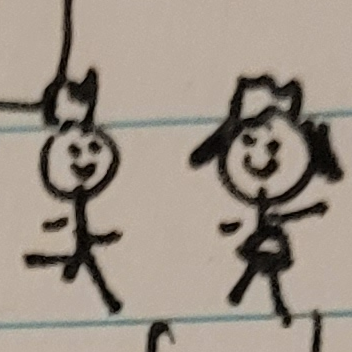
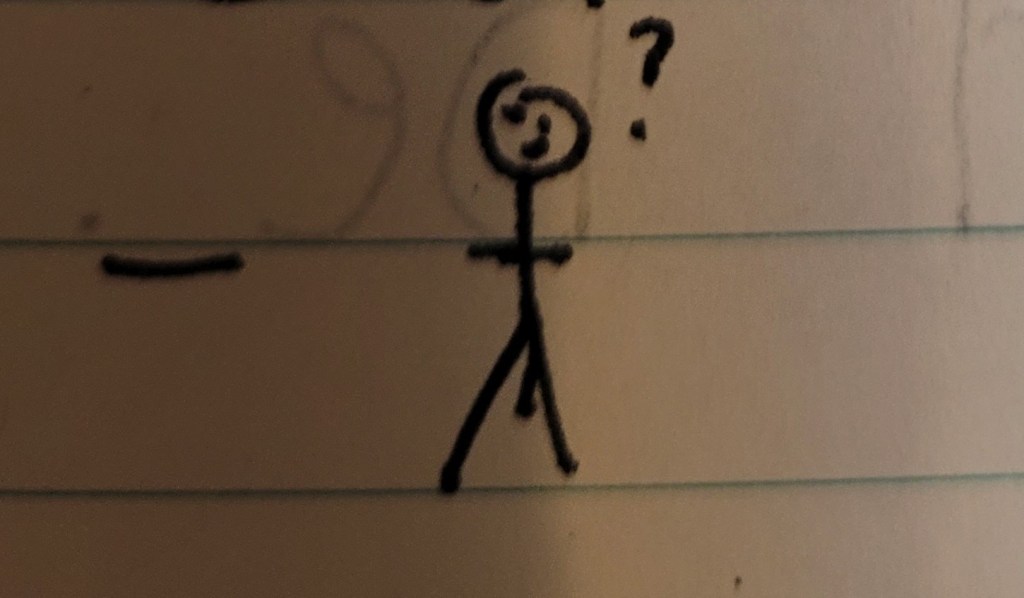
We presume you’re wondering where these stick figure drawings that accompany our posts come from. Well, except for the one with the Renfield post, which was purpose-drawn, they’re all from our daily journals from the late 1990’s. We were big journalers back then. We started doing it intermittently, after we began to work with our first therapist on therapeutic kinds of things, and carried on with it as we began to read our way through the literature on abused children and recovery from abuse. Things really got serious when we read Julia Cameron’s The Artist’s Way and did the 10-week course outlined in that classic work.
This was near to 30 years ago, when that book was new and we were trying to make it as an actor in LA, and pretty much everyone in the entertainment business, it seemed, was doing The Artist’s Way, or planning to do it, or thinking about putting it on their calendar, and one of the easiest ways to get a conversation started in a coffee shop was to have your copy out and visible.
A core tool of The Artist’s Way is Morning Pages, three pages of free writing with which you start your day. Apparently, many a book, screenplay, or whatnot has had its origin in somebody’s Morning Pages, and over a quarter-century after I turned my last morning page it seems that my own manuscript is one of them. Transcriptions of our morning pages litter the pages of Not a Monster, including conversations among my inner children and I that hint about writing a book about our work together.
And, to answer your presumed question, the stick figure drawings come from those very same morning pages.
But that’s not what this post is really about, which we presume you knew from the title.
The real matter of the post
The real matter of the post has to do with how long it took me to start adding drawings to the morning pages. Julia Cameron’s instructions said nothing about drawings, and it took us about 15 months to liberate ourselves sufficiently to start adding anything to the text that couldn’t be reproduced on a keyboard.
I gather, that we, like many and many a morning page writer, spent more than a little time expressing on the pages our fear that we were writing the pages wrong. Whatever might be the case, though, for other people, this is exemplary of a larger truth of our life, an enormous part of which has been dedicated to getting things right.
I do not mean by this that we have been dedicated to following the rules. We have, no doubt, often followed the rules, wittingly or otherwise. We have however been both predisposed and pleased to break the rules when and where and as often and – this is very important – as cleverly and as elegantly as we could.
BUT: we still, absolutely, had to get things right.
Does that make any sense to you? That I need to get it right even when I break the rules? That, for me, even doing things wrong needs to be done correctly? I’m guessing that to some of you, it absolutely does make sense; I’m not sure that we can explain it to the rest of you. Not sure that I’ll even try, here, since there are other things that I want to get to today.
Which is writing with white space. We purposely don’t indent our paragraphs (when we can get away with it) in order to have that white space, which we consider to be meaningful, and if we were reading this aloud to you, you would hear that space, just as you would hear our punctuation marks.
(Doubt that you would hear the color, though, which isn’t actually white, here, is it?)
In fact, in the years that I taught high school English, I used to teach my students to read and interpret the “empty” spaces on the printed page as carefully as they did the “filled” portions, to spend equal amounts of time on both – though, truthfully, there usually is less to interpret in the white or off-white portions.
To return, though, to therapeutic, rather than artistic or phatic, writing, my early days of journaling tended to produce passages that looked like this:

or, on a better day this:
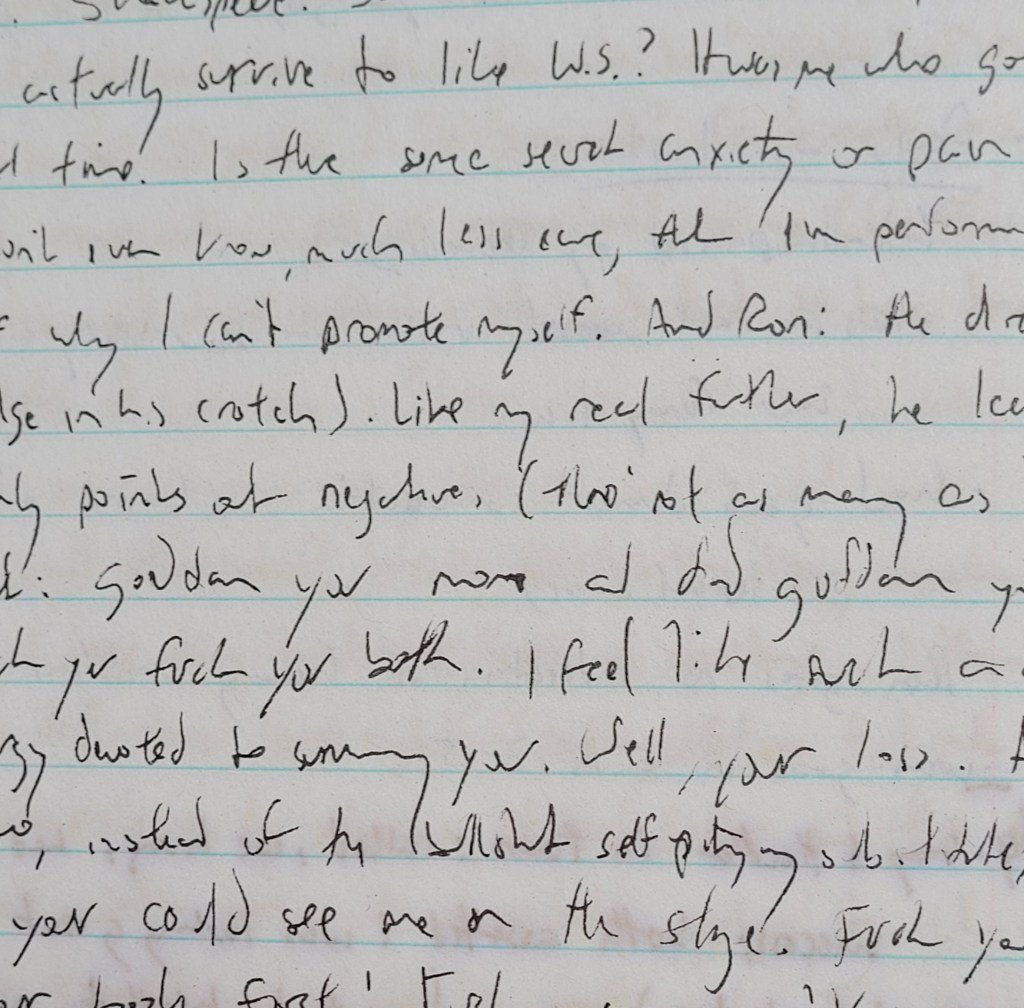
These are pretty good examples of doing it right, wrongly: unpremeditated, uncensored, unrelenting dumping (that’s proper), but just ugly, in so many ways, just undignified. Even when they’re readable, they’re skanky:
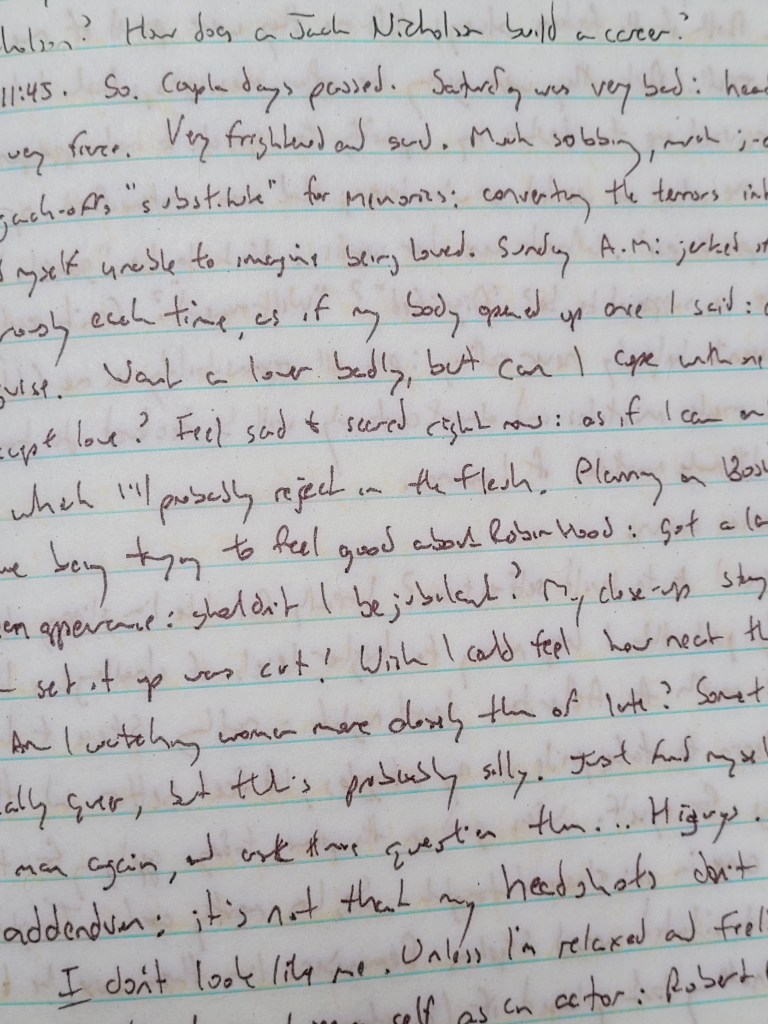
These are, like I said, the dumping journals, the pouring it all out journals, where your goal is a mind cleared of garbage. If you bothered to try to decipher any of that, you may have noticed some exchanges with a few of my inner children, but there’s not a lot of room for that, or for the breathing space that white space on the page indicates.
A few months into the Morning Pages (I’m never sure if I should be capitalizing that – I periodically go back to the book [still have my original copy] to see if Cameron and Bryan did, but then I forget almost immediately. Same with “Inner Children,” when I look that up in the appropriate sources.), I’d gained the nerve to write in short paragraphs:
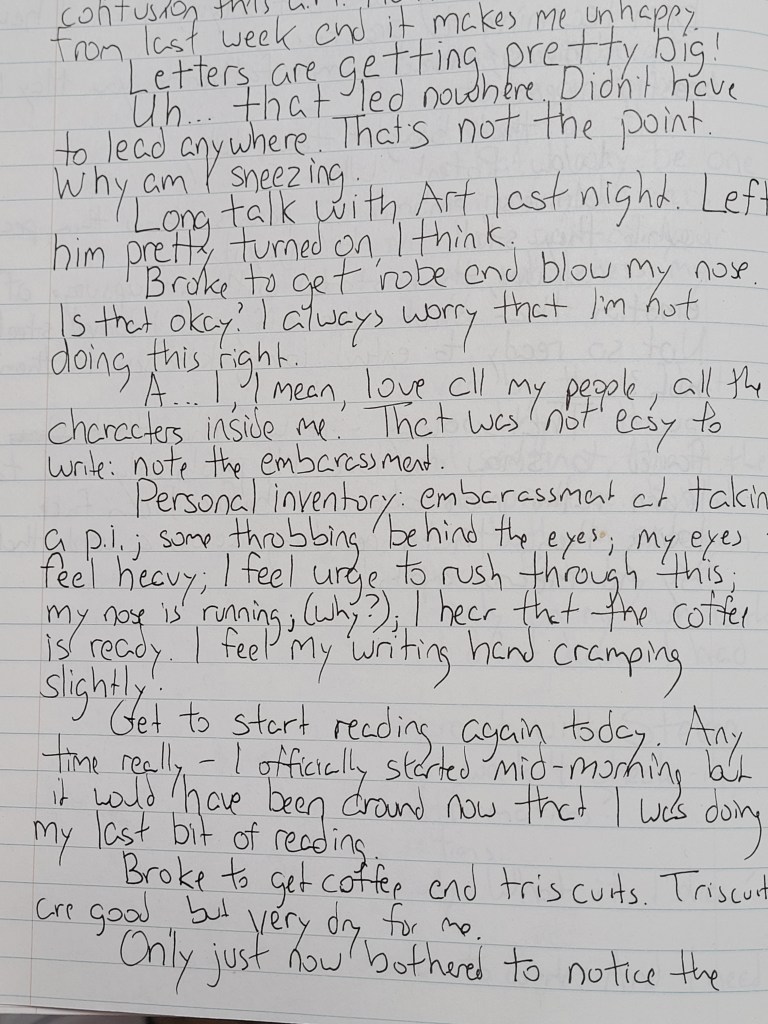
That’s not necessarily typical – longer paragraphs were the norm until we’d finished the 10-week course and felt freer to go our own way. By then, it had turned into a dialogue among many voices and we’d once again lost control of our writing as everyone rushed to get a word in.
Big Letters to the Rescue
But some while before, outside of the Morning Pages, we’d developed a practice we called “Big Letters,” which was just what it says on the tin: writing as if we were just learning how, drawing the letters from the top of the line to the bottom. Sometimes we’d actually use two lines, so we could get that mid-line effect for the lower cases and the bottom part of bs and ds and whatever.
That slowed down our capacity to express everything in our head, and which – when it didn’t frustrate the hell out of us – reminded us that, no matter how fast you go, no matter how close your handwriting gets to a straight line, your hand will never keep pace with your head, so why bother? Let your concentration on a perfect letter edit things down to an essence. I suppose that if had supplemented my study of Taoism and Tai Chi with calligraphy, I might have learned that and saved some time.
Big Letters led us, indirectly, to pages of material that could barely, if at all, be called writing:
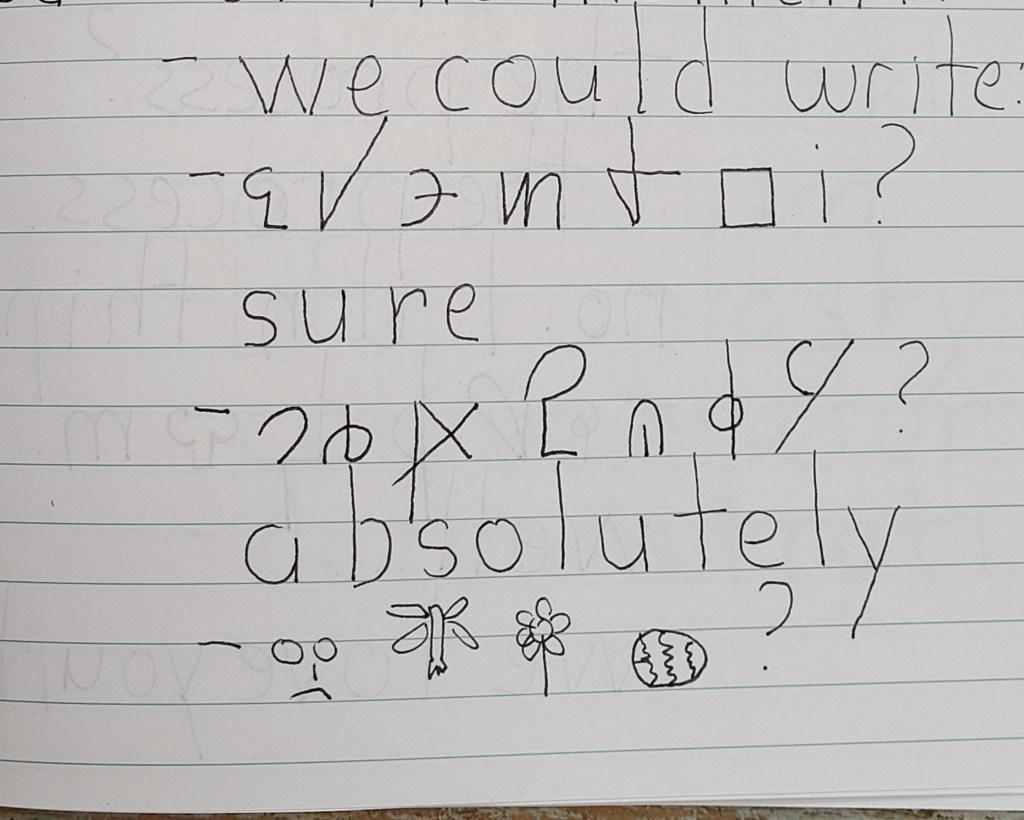
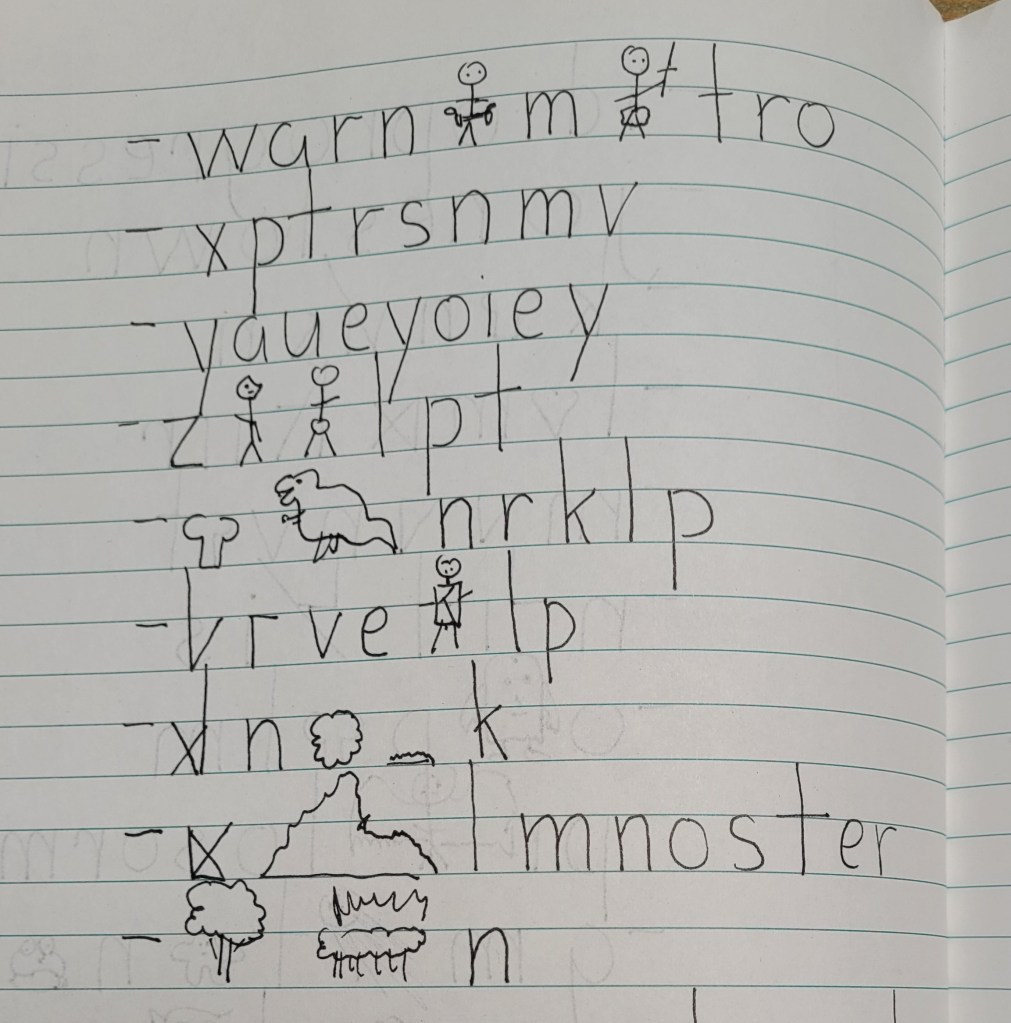
The allowance of time and space created by that tom-foolery in turn created openings for the crew (some of whom drew themselves on the page above) to start generating narratives, poetry, and other forms of expressive self-discovery. You perhaps have discovered how the release of self-control is required to allow the discipline of creativity. Given the rigid self-control I – like many – had to develop in order to survive my childhood, it took me a long time and silly means to discover it for myself.
A Prayer
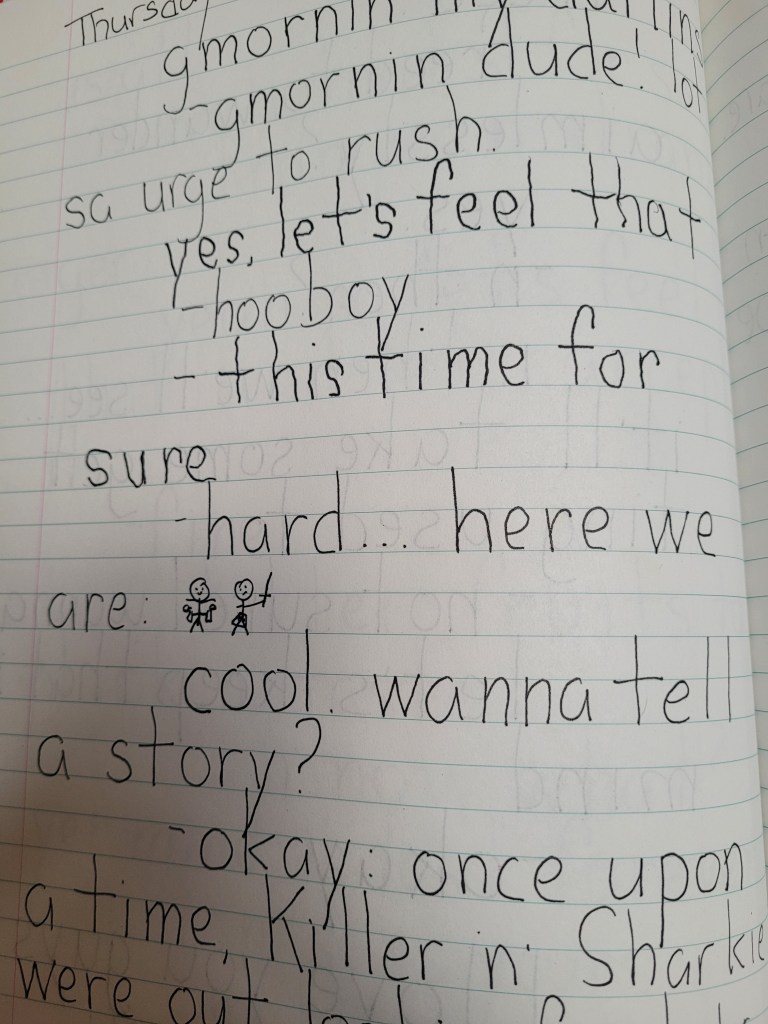
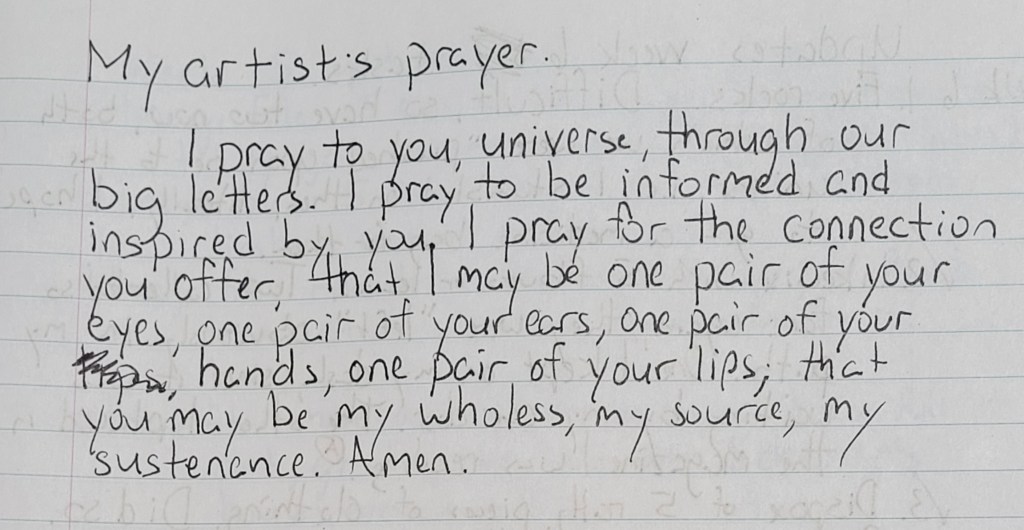
We’ll wrap up with one other element of Cameron’s The Artist’s Way: the creation of an “artist’s prayer” for yourself, which one does early in the program. Here’s ours, as written down – not quite error free or totally in big letters – in an early Morning Pages journal:

 The Anarchic* Psyche of Michael A Leavy
Leave a comment